PrintJoy guides · journal ephemera
Printable journal ephemera: word strips that look collected, not photocopied
Ephemera is the small paper that makes a journal page feel lived in: tickets, labels, word strips, scraps. Printed strips can look like a photocopy or like something you picked up on a trip, and the difference is mostly paper, scale and cutting. This guide covers all three, plus a free maker that lays out a full sheet of strips.
6 min read
Key takeaways
- Print strips on 80-120 gsm paper; card stock looks like a label, not a scrap.
- Vary the strip widths in one sheet so the page does not look like a grid.
- Tear, do not cut, at least half the strips; a torn edge reads as found paper.
- Print a month at a time and store the strips flat in a small envelope.
What makes paper feel like ephemera
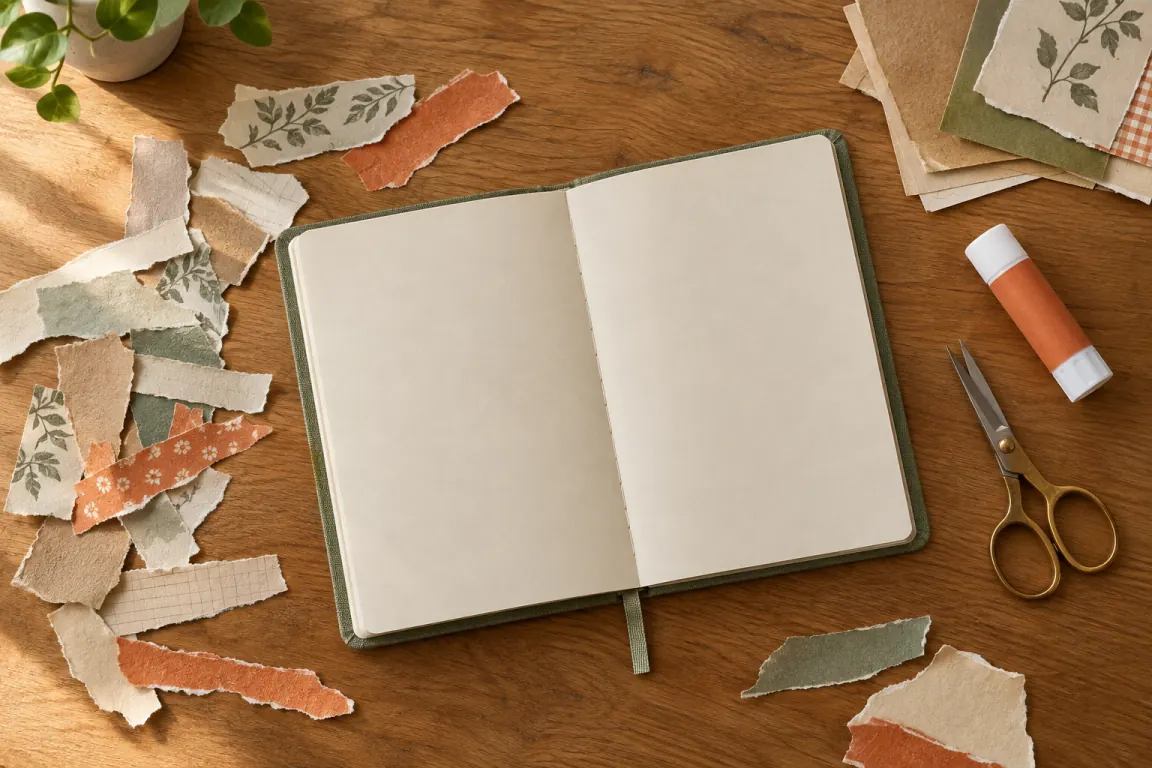
Ephemera is paper that was never meant to be kept: a ticket stub, a luggage tag, a receipt, a strip of wrapping paper. It feels collected because it has uneven edges, a limited palette, and a size that was decided by someone else. A printed strip can imitate all three, but only if it stops looking like a sheet of labels.
The first signal is scale. Real ephemera is small: a word strip is often 10-20 mm tall and 60-120 mm wide. The second is the edge. A guillotine cut is perfectly straight and instantly reads as a printout; a torn edge has a fibre line that reads as paper. The third is repetition. A page of identical strips looks like a product; a page of varied strips looks like a collection.
None of this requires special equipment. A ruler and a dull craft knife give a torn edge, and the maker already varies the strip widths so a single sheet does not look like graph paper.
Sizes that work in a journal
A5 and A6 journals take strips between 10 and 25 mm tall. Below 10 mm the strip is hard to glue without wrinkling; above 25 mm it covers too much of the page and stops being an accent. The width can vary from 40 mm for a short word to the full page width for a phrase.
Print a mix on one sheet: a few full-width strips, a few half-width strips, and a few short labels. The variety is what makes the page look assembled rather than printed. The maker cycles the phrases through the strips, so a list of ten phrases produces a sheet with no immediate repeats.
If you are printing for a specific project, choose the palette first. A warm cream, a faded coral and a soft charcoal cover most journal styles. Avoid pure white; it reads as office paper next to almost any journal page.
- Height: 10-25 mm for A5/A6 journals.
- Width: mix 40 mm, half-page and full-page strips.
- Palette: cream, faded coral, soft charcoal — not pure white.
Make a sheet in three minutes
Type the first phrase and the sheet caption, then add the rest of the phrases one per line. The maker cycles the list through the strips, so the order of the list is the order of the sheet. Shuffle the list if you want the phrases to sit next to different neighbours on a second print.
Choose Letter or A4 and download the PDF. Print a proof on the paper you intend to use; the same layout looks sparse on 80 gsm and crowded on 200 gsm because the strip height changes the number of strips per sheet.
If the phrases are for a specific journal, keep them short. "the good part", "small hours", "not yet" are better than full sentences. A sentence on a strip becomes a caption; a phrase becomes a texture.
Try it here
Free word strip maker
Add phrases, one per line, and download a sheet of strips in mixed widths, ready to cut or tear.

300 dpi output · US Letter 8.5 x 11 in. Layout and downloads stay on this device. PDF includes every page; PNG includes the selected page. Print at 100%, with printer scaling off.
Paper, cutting and the torn edge
Use 80-120 gsm paper. Standard copy paper works if it is not too bright; a slightly textured writing paper is better. Card stock is the wrong weight: it sits on top of the journal page instead of becoming part of it.
Cut along the printed lines with a guillotine for the strips you want straight, and tear the rest. To tear a clean line, score it with a ruler and a dull knife, then pull the paper slowly against the edge of a table. The result is a soft, fibrous edge that reads as found paper.
Ink matters as much as paper. Laser prints sit on the surface and can crack when the paper is folded; inkjet prints soak in and can smudge with glue. If you are using a glue stick, test one strip first. A dry glue stick and a light hand are better than a wet one.
Storing strips so they get used
Store the strips flat in a small envelope or a plastic sleeve, sorted by palette. Strips that live in a drawer get bent and forgotten; an envelope on the desk gets used. Keep the envelope next to the glue, not next to the printer.
When you build a page, place the strips before you glue them. Three strips of different widths, overlapping by a few millimetres, look deliberate. One strip centred on the page looks like a label. The composition is the difference.
Do not hoard the sheet. Ephemera is meant to be used; a full sheet in a drawer is potential, not a journal page. Print a month at a time and let the strips run out. A new sheet is a few minutes away.
- Flat envelope, sorted by palette, next to the glue.
- Place three strips of different widths before gluing.
- Print a month at a time; running out is part of the system.
Other ephemera the same workflow produces
The same maker produces labels, tabs and small tickets by changing the phrases and the strip height. A sheet of tabs for a planner is a sheet of short strips with a fold line; a sheet of tickets is a sheet of wider strips with a number and a date.
If you need shapes, print the strips and punch or die-cut them after printing. A corner rounder turns a strip into a tag; a small circle punch turns a label into a confetti piece. The printed sheet is the raw material, not the final object.
For a gift, print a small sheet, tear the strips, and put them in a glassine bag with a note. The bag is a better gift than the sheet because it is already in the form the recipient will use.
Questions about this guide
What paper is best for printable journal ephemera?
80-120 gsm paper, ideally slightly textured or cream. Card stock is too heavy and reads as a label rather than a scrap.
How do I get a torn edge on printed strips?
Score the line with a ruler and a dull knife, then pull the paper slowly against the edge of a table. The fibres separate unevenly, which is what makes the edge look found.
What size should word strips be?
10-25 mm tall for A5 and A6 journals. Widths from 40 mm to the full page, mixed on one sheet, give the page a collected look.
Can I print the same phrases on every sheet?
Yes, but shuffle the list between prints so adjacent phrases change; a repeated layout looks like a product rather than a collection.
Is the word strip maker free?
Yes. The layout and the PDF download are free without an account.
Related guides
Printable Habit Trackers That Get Used
Why most habit trackers are abandoned in a week, how to choose three habits that fit one page, and a free tracker maker with editable row labels.
6 min readFree gift tag makerHow to Make Gift Tags That Look Finished
A practical guide to making gift tags at home: the five decisions that make a tag look finished, print settings, and a free tag maker you can use now.
8 min read